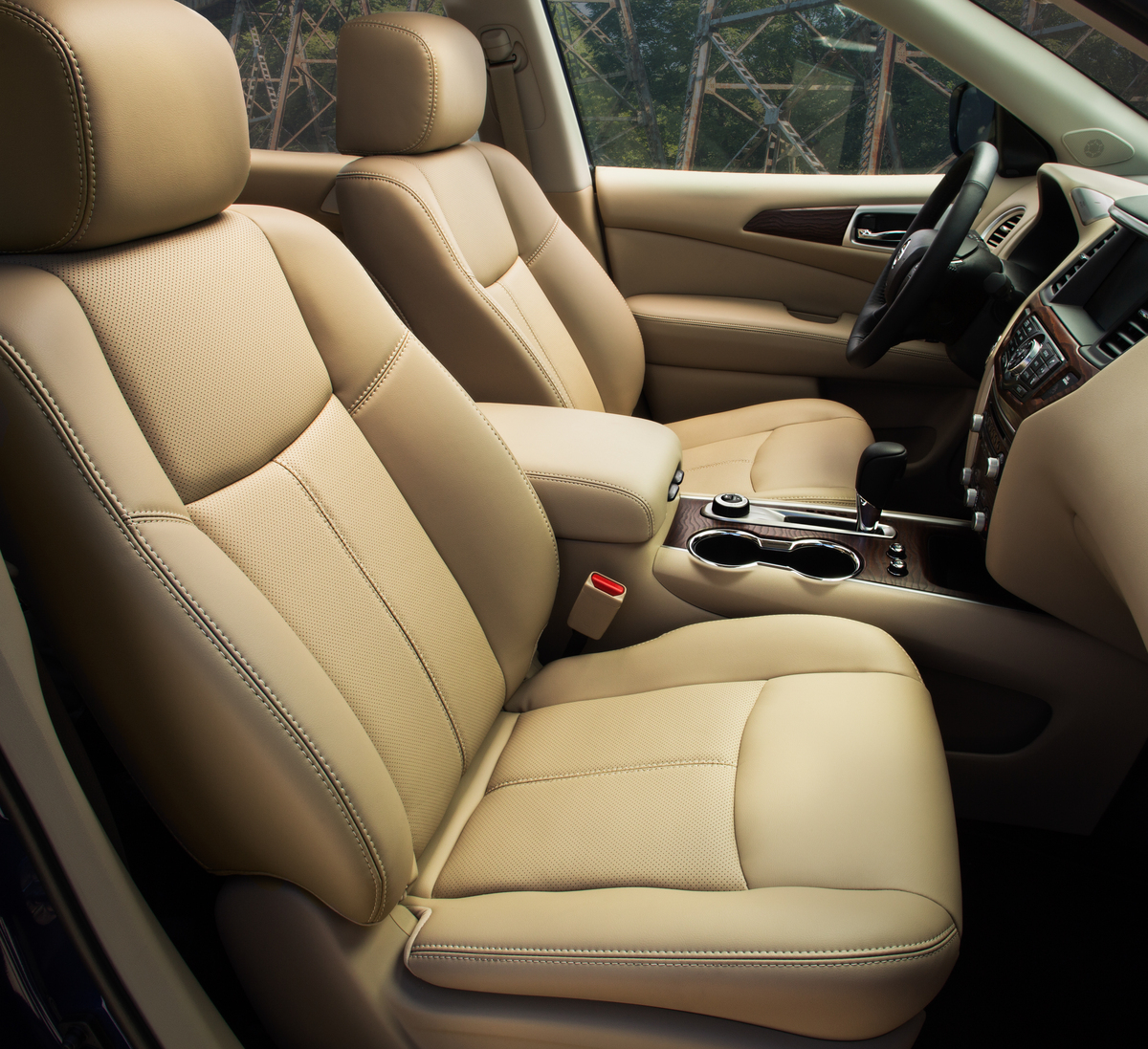
EV Rider reviewer Dan Scanlan has the new compact truck to test, and the 2025 Nissan Frontier been freshened as well as given a taste of its 1980’s self, when it was known as the Hardbody.
This generation Frontier is three years old, and gets a bolder face with some Hardbody cue, plus a neatly revamped interior look with more tech, yet the same utility we like in a Frontier – like a 6,700-lb. tow rating and as high as 22 mpg.
Read lot’s more about this truck, and see more interior and exterior images by EV Rider reviewer Dan Scanlan – Nissan Frontier Gets Upgrades For 2025 – right here. And check out lots more views of EV, PHEV and ICE vehicles at EV Rider.
There’s a stick in the middle of this blue Nissan Z’s cockpit – a stick shift, that is, meaning a 6-speed manual transmission with auto-revs on downshifts if you want. And that makes this seventh-generation Z – done in a new-for-2025 Bayside Blue seen on GT-Rs – a rare beast for that and other reasons.
First, only about 1% of vehicles sold new in the U.S. have stick shifts, vs. 35% back in 1980. And even though this Z generation’s been out for a few years, it’s rare – about 3,100 sold nationwide in 2024, up from just under 1,800 in 2023, and just 262 in 2022, when it was introduced to replace the 370Z.
But like they say, it may be an oldie, but it’s still pretty much a goodie in a world lacking in relatively affordable sports coupes.
Hanging out at some recent cruise-ins with the true-blue Z, we easily noticed lots of styling cues from past Z’s also on show there, as this iconic Japanese sports car hits its 55th anniversary of when Yutaka Katayama brought out that first 240Z in 1970. Let’s forget that there were no Zs between 1997 and 2002, OK?
The overall silhouette of the 2025 Z – just Z – is so similar as we parked next to a pair of pristine first-gens, with long noses and fastback rears. The long hood’s power bulge is pure homage to the first Z, as is the “Z” badge on the fastback’s sides.
Defined upper design lines run off LED headlights with almond-shaped DRLs, flowing over flared front fenders. The raked windshield flows over a sloping roofline that also echoes Zs of old, while side window shape taper to the rear just like a 370Z – folks loved the roof’s subtle silver side accents that mimic traditional Japanese katana sword blades.
The streamlined scalloped door handles front wide rounded rear fender hips, also like the 370Z’s taper, this latest generation ending in a lip spoiler over black-framed red LED taillights that echo 300Zs. There’s a black lower fascia with aero fins framing big stainless steel exhaust pipes.
The Z rides on black 10-spoke RAYS alloy wheels wearing staggered 19-inch Bridgestone Potenza rubber, red NISSAN-badged calipers clamping big discs, visible between the spokes. And the new 167.2-inch-long Z rides on basically the same 100.4-inch wheelbase as the 370Z, but is 5 inches longer die to that sharper nose that really carries 240Z in the large, rectangular grill design with 24 rounded silver slots that match taillights . And it’s fairly low 52.2-inch height is about waist-high for me.
It’s rare – I only saw one other on the road – but it drew folks to gander at cruise-ins, and older Z owners nodded in approval.
Those same folks loved the gray-over blue interior, with synthetic suede and leather seats and their serious side bolsters, the blue wrapping the lower dash and console. There’s more retro, like jet exhaust-style inside door handle/air vents that look like the last-gen 370Z, which was around for nine years. Top-center dash, a trio of slightly recessed gauges like the 350Z – turbo boost, turbocharger speed and electrical. And those seats – power slide and seatback tilt, with manual height –firm and very supportive. The padded suede-accented doors were also appreciated.
The stitched leather-clad steering wheel has thin spokes with controls for audio, smart cruise and the digital gauge under a hard plastic cowl, capable of three formats – Refined (simple digital), normal (180-mph speedo and 8,000-rpm tach with center info screen), and Sport (big center 8,000-rpm tach, engine gauges and configurable screen that offers turbo boost, G-force and other info). Sport also gives green/amber/red rev limit tally lights over the tach, which has a 7,000 rpm redline.
There’s a big center touchscreen with navigation, phone, weather, traffic and gas info, plus main menu buttons lining the base and a real volume and tuning knob. Classic, big a/c knobs are below. Dual USB ports live lower with a rubberized slot for a cellphone – no inductive charging, and no wireless Apple Car Play or Android Auto. The screen and voice command functions also take up to a minute to spool up.
Stitched padded blue leatherette borders a cup holder with stubby gearshift near seat heat and electronic parking brake buttons. The low center armrest hides slim storage, and slides aft to reveal a second cup holder and 12-volt outlet. There’s decent carpeted space behind both seatbacks for a briefcase or more. But the high beltline make for a cozy cockpit, with some neck craning to see what’s coming up he sides – there’s blind spot warning.
Just like the 350Z and 370Z, there’s an alloy crossbar at the front of the shallow trunk under that sleek fastback for body stiffening, room for soft bags here and that’s it, always visible – a cargo net is in a bag Velcro ’ed to the carpet.
Here’s the facts –our 3,602-lb. Z has a twin-turbocharged 3-liter V-6 with 400 hp at 6,400 rpm, and 350 lb-ft of torque from 1,600 to 5,200 rpm, a 6-speed manual transmission handling the gears. It’s covered by a plastic panel, a strut brace over it to stiffen up the works.
Even in Standard mode, our 3,000-mile-old Z launched quickly off the line, V-6 sweetly snarling to 60 mph in 4.7 seconds with a hint of wheelspin at launch and the 1-2 shift. In Sport mode, we had more aggressive engine action to hit 60 mph in 4.5 seconds, a hint more wheelspin in the shift before the rubber grabbed.
The clutch bit quick and smooth, shifter throws light and precise but a bit notchy – auto-rev matching for downshifts is appreciated, with a nice throttle blip.
The G-force meter shows the Z pulls a solid .8Gs on launch as traction control neatly reins in most wheelspin. The engine snarl is a delight without being too annoying, but could be a bit sharper. Those rev lights across the gauge display are cool, but not used much in practice. And tall cups in the cupholders get tapped by the right elbow on shifts.
It averaged just under 20 mpg in spirited driving, mostly in Standard mode, where the V-6 didn’t lug in sixth even when as low as 1,000 rpm. There’s power across the band, passing neatly at highway speed in top gear – a 2-second hill holder is appreciated on starts.
All recent Zs I’ve tested have serious playfulness in curves, but were comfy as grand tourers – the latest is the same. There’s a familiar double-wishbone front suspension with diecast aluminum subframes, and an independent multi-link rear suspension with monotube shock absorbers all-round.
The result is a taut and tightly-controlled, yet supple with potholes handled quickly, a nicely buffered rebound on compression over even some nasty speed bumps. Sharper-edged bumps got a tighter response, but it still isn’t choppy – they are mostly smothered.
Weighing in at 3,536 lbs., didn’t feel as crisp as some lighter sports coupes I’ve tested. But it could be coaxed into a bit of tail-out in corners, easily catchable via throttle as traction control smoothly assisted. On our skidpad, it pulled a steady 1.1 Gs, and even felt fairly flat and very grippy on sharp corners, where it was happy and controlled. The electric-assist power steering had a firm, linear and direct feel, loading up nicely in feel. And those vented disc brakes with 14-inch front/12.1 rear rotors – some joked almost as big as the wheels – had a precise bite high up and great control, no fade and minimal nose dive. And hard stops also garnered a respectable 1.1Gs – that’s serious hang-in-your belt territory.
Call the Z a very nice long distance touring car with all the sport you might need, yet quiet enough, composed and perfectly fine with a commute, or fast corner.
The new Z – just Z – starts at $52,970 for the Z Performance, with standard 5-way mechanical limited-slip differential, RAYS forged alloy wheels, 4-piston front calipers with 14″ rotors and Bose Premium Audio. With $450 paint,$415 premium mats and a few other small options, the final price is $55,985 – which surprised some folks.
Comparisons include the Subaru BRZ/Toyota GR86 brothers as well as the Toyota Supra and Mazda MX-5 Miata RF hardtop convertible. The Supra has 382 hp and 368 lb-ft of torque from a 3-liter twin-turbo six-cylinder. The BRZ/GR86s get a 228-hp four, and is a bit less yen. The Miata gets a 181-hp four, and is also cheaper – and 1,000 pounds lighter. All of them are a bit sharper in handling, the BEZ/GR86 twins really great to play hard with without any vices, the Supra sexiest in looks, the Miata just plain fun – your decision.
Bottom line — Looks that will kill, a hint of enjoyable analog with digital – speed and handling as well as real presence, power and ability.
“I was in a head on collision that totaled my 2012 mustang GT. A few weeks later I met my (soon to be) wife and consulted her while I was in the market for a new car. After having one sports car totaled I was not discouraged in my ownership of a performance driving machine.
I was considering the 370Z, GT86, and 2017 Camaro ZL1. I was a few months from being deployed so it was ether get something lower down now or wait till post deployment and get a ZL1. I decided to get something then and build it up as I went. I had a friend take me to the nissan dealership as they had the base model 370Z.
Cody’s 2017 Nissan 370z on the showroom floor with 67 miles on the odometer. Magnetic black with graphite grey wheels and black interior. Photos courtesy of Cody.
After sitting in it I was set, I didn’t even need to go look at the GT86. Four hours later after a lot of haggling over the price I walked out with the keys to a 2017 Nissan 370Z from the show room floor with 67 miles on the odometer.
One of the first things I did was drop in a set of resonated down pipes to get rid of the constricted exhaust sound. As I was working on this I had just removed the cats when the auto hobby center on the base had to close. I left, moving my car with open headers out of the shop and to the parking lot where I was hit by a distracted driver on the driver quarter panel and wheel and he pushed on and creased my door as well. Insurance covered the $4,500 in damage. The collision center worked on my car after I left for deployment just two days after the accident. My wife, who was my girlfriend at the time, and her mom picked my car up from the shop for me.
Upon returning home for a month break in our deployment, I installed my down pipes. Sounded amazing but there was still some restriction from the factory intakes. After that deployment I married my wife. A few months passed and we began working up to another deployment. I had to leave for a month in the middle of moving into our new house. When I returned my wife had bought me a cold air intake I had been looking at before I left.
With the restrictiveness of the factory components removed I put the breaks on modifications for few months then I bought a set of pedal covers, a 5 point harness, and weighted shift knob. Fast forward till after second deployment and I got a bucket seat where in I manufactured my own seat brackets. After that it was time for new tires and with that I installed slotted rotors and higher temp brake pads. Puts us at the current time in history.”
Cody’s Story
“I was born and raised in Alaska. Single income poverty line family of six. My step dad worked in construction and as a hunting guide during summer months. Winters were slow for him, so we were always under the pressure of making bills.
Cody and his Z .
As I grew up I was interested in trucks, dirt bikes, guns, and airplanes. The last I pursued to a great extent; working at the local airport for an aircraft mechanic as work study at the age of fourteen. I was home schooled, so it was not uncommon for me to do my school late in the evening after spending eight to ten hours in the hanger. I was also a participant in the Talkeetna branch of Build a Plane.
After my boss at the airport moved, I went to work for a machine shop making aircraft parts but was forced to quit after my school load took up too much time and I was unable to balance a full time job there. Later that school year I went to work on tourist aircraft for a few months.
Cody’s favorite co-pilot
After graduating I enrolled in AVTEC, a trade school in Seward AK. I started in their industrial electrical program but due to difficulties in understanding and keeping pace with the other thirty one students, the two instructors encouraged me to move to a different program. I did and found a last minute seat in the structural welding program.
Now for a later life point of view – I was not the greatest student. But I had a natural talent for welding and it was the program I initially wanted to get into but it had been full at the time I had enrolled earlier. After graduating with high marks. I went to work for my parents company that was still in the process of growing while I waited for my resume to be noticed. But after half a year I enlisting in the navy as an AE.
After boot camp and initial schooling I got orders to a helicopter squadron in Jacksonville Florida. Where I discovered trucks were impractical, but sportscars?
Thus my car guy phase started and has been fueled since, with no indication of stopping.”
Interested in showcasing your ride? Send us a message at chris@firstcoastcarculture.com
Ruthless. A fitting word to describe the competition in the mid-size family sedan marketplace. Juggernauts from Toyota and Honda continually take top sales numbers with their respective Camry and Accord. KIA and Hyundai fight for consumer dollars with the Optima and Sonata. Everyone of them is a great vehicle, all are worthy of consideration.
Last year, Nissan redesigned their entry into the mid-size family sedan segment. The resultant all-new Altima deserves a place right along the top contenders. With attractive styling, a comfortable amenity-filled cabin, advanced safety tech and a pair of capable engines and transmission, the new Altima shines.
Powered by the base 2.5-liter inline 4-cylinder engine, with is rated at 188 horsepower and 180 lb-ft of torque and a CVT transmission, the base Altima offers excellent fuel economy with up to 28/39 city/highway mpg.
Consumers living in colder climates will appreciate the addition of all-wheel-drive, which is available on all trim levels equipped with the 2.5-liter 4-cylinder engine. The “intelligent” all-wheel-drive system automatically detects road conditions and redistributes power to the front wheels accordingly.
The turbocharged Altima is powered by a 2-liter turbocharged inline4 that makes 248 horsepower and 273 lb-ft of torque. The smaller, but more powerful engine helps make the Altima a better enthusiast’s choice, although the CVT transmission tends to remind the driver that the Altima is also a gas sipper. The turbocharged SR and Platinum FWD models are rated at 25/34 city/highway mpg.
On the road the Altima is a compliant vehicle that does what you ask of it. Daily commuting ticks by without incident and weekend family outings are comfortable. The standard 8-way adjustable drivers seat makes finding a comfortable driving position easy. Nissan’s “zero-gravity” seats are some of the most comfortable in the segment.
Rear passengers are given plenty of legroom. While we wouldn’t want to plan a cross-country road trip for 5 grownups, three adults will find the rear seats accommodating for short trips around town. The trunk’s 15.43 cubic feet of cargo space is in line with the segment, besting Camry (15.1) but sitting below Accord (16.7).
The five 2020 Altima Trims Levels at a Glance:
S, SR, SV, SL and Platinum
Front-wheel-drive is standard. Models with the 2.5-liter engine and are available with all-wheel drive. Altima SR and Platinum grades are available with the 2.0-liter turbocharged engine.
Altima S includes standard Automatic Emergency Braking, Intelligent Driver Alertness, Bluetooth Hands-free Phone System, Rear View Monitor, NissanConnect with Apple CarPlay and Android Auto, 7-inch Advanced Drive Assist Display, Remote Engine Start, 12-volt DC power outlet, four front/rear USB charge ports (Type-A and Type-C), 8-way power driver’s seat, 60/40 split-folding rear seat, Rear Door Alert and more.
Altima SR adds 19-inch aluminum-alloy wheels, unique rear diffuser color, sport suspension (FWD only), sport interior with sport seat, paddle shifters, leather-appointed steering wheel, LED projector headlights, dark chrome grille, Nissan Safety Shield 360, exhaust finishers, black side mirror caps and body colored door handles.
Altima SV includes a moonroof, LED fog lights, 17-inch aluminum-alloy wheels, heated front seats and steering wheel, ProPILOT Assist, Lane Departure Warning (LDW), Rear Automatic Braking (RAB), heated outside mirrors with LED turn signals, 2-way power lumbar support, High Beam Assist (HBA), rear console HVAC vents and Dual Zone Auto Climate Control.
Altima SL adds a Bose premium sound system with nine speakers, NissanConnect with Navigation and Services, Traffic Sign Recognition, leather-appointed seats and 4-way power passenger seat.
Altima Platinum includes 19-inch aluminum-alloy wheels, Intelligent Around View Monitor, interior accent lighting, and driver memory seat and mirrors function.
Pricing for the 2020 Nissan Altima starts at $24,300 plus fees.
The attractively-styled 2020 Nissan Armada features a powerful V8 engine and a luxurious interior with seating for eight. Introduced for the 2017 model year, the second-generation Armada provides a premium experience for a price well below comparable premium full-size SUVs.
Nissan’s Armada uses body-on-frame construction that provides off-road capabilities and the towing capacity of a pickup truck, up to 8,500 lbs. The construction also gives the Armada a strong presence on the road. Nissan’s 5.6-liter V8 engine produces 390 horsepower and 394 pound-feet of torque. The giant V8 is quite welcome in a world that seems to be taken over by small displacement turbos All Armada models use a 7-speed automatic transmission. Rear-wheel drive is standard and four-wheel-drive is available. Fuel economy is rated up to 14/19 mpg city/highway.
We found that the Armada’s precise steering and well-tuned suspension worked well for daily driving activities and that an extended highway trip confirmed the quiet luxurious nature of the SUV. It is easy to forget that the Armada is not a premium-branded vehicle. The powerful powertrain and refined suspension yield a driving experience that is similar to more expensive vehicles from competing manufacturers.
Armada’s family-friendly interior is spacious, quiet and comfortable. The standard heated front seats are comfortably padded, but could use more by way of support. The ten-way power adjustable driver’s seat and the tilt/telescopic steering wheel make it easy to find a comfortable driving position. Nissan’s use of soft-touch surfaces, attractive design and trim add to the Armada’s premium feel.
The Armada’s second row provides comfortable seating for three adults. The 60/40 folding third row is designed for three, but is better suited for two adults. The Armada provides 16.5 cubic feet of cargo space behind the third row and increases to 49.9 and 95.4 behind the second and third rows respectively.
The Armada’s standard audio system includes an 8-inch touchscreen, 13 speakers, four USB ports and Bluetooth connectivity. The system also includes standard navigation, HD and satellite radio. Nissan’s decision use a premium-branded system and include navigation helps bolster our argument that the Armada is actually a premium/luxury vehicle for a non-premium price.
Which Armada Trim Works for you?
The 2020 Nissan Armada is available in SV, SL, Platinum and Platinum Reserve models with 2WD or 4WD.
Armada SV features 18-inch alloy wheels, a tow-hitch receiver, chrome door handles and contrast painted roof rails, running boards and overfenders.
Armada SL adds Nissan Intelligent Key, Remote Engine Start System, power 60/40 3rd row seat, Intelligent Around View Monitor, power liftgate and 20-inch wheels and tires.
Armada Platinum includes power-sliding moonroof, front climate-controlled seats, a family entertainment system, “Nissan Safety Shield” technologies and the Intelligent Rear View Mirror.
Platinum Reserve adds dark chrome exterior trim, dark grey skid plate and tow hatch cover and two-tone leather-appointed seats, interior trim with unique stitching and 22-inch wheels and tires.
Four option packages are also offered.
The Driver’s Package (SV only) includes fog lights, auto-dimming rearview mirror with HomeLink, power 60/40 3rd row seat, power liftgate and trailer towing harness and pre-wire and connector for brake controller.
The Captain’s Chairs Seat Package (SL and Platinum) replaces the 2nd row bench seat with 2nd row Captain’s Chairs and 2nd row center console with padded armrest.
The Premium Package (SL) includes Intelligent Distance Control (I-DC), Blind Spot Warning (BSW), Intelligent Back-up Intervention (I-BI) and power sliding moonroof with front tilt and rear slide. And finally, the new 22″ Wheel Package features 22-inch wheels and tires.
Pricing for the 2020 Nissan Armada starts at $47,500 plus fees.
Powered by a time-tested V6 engine, the 2020 Nissan Pathfinder offers strong performance and excellent towing capabilities. Families will appreciate the spacious interior and cargo space. Enthusiasts will find the “Rock Creek Edition” to have a fun throw-back appeal, kindling fond memories of the brutish Pathfinder of the 1980s and 1990s.
For 2020, the Nissan Pathfinder is available in five trim levels: S, SV, SL, Rock Creek Edition (SV and SL) and Platinum. The V6 is paired with a continuously variable transmission (CVT) and front-wheel drive. An all-wheel drive system is available for an additional $1,690.
Nissan refreshed the Pathfinder’s in 2017 and the SUV remains relatively unchanged for the 2020 model year. The SUV’s headlights and “V-Motion” grille align with rest of Nissan’s lineup. Base models come with 18-inch alloy wheels and Platinum trims receive 20-inch versions. Our Rock Creek Edition tester sported a nice set of 18-nch dark-finished aluminum-alloy wheels and all-season tires. The Rock Creek package also includes a black front grille, side mirrors, front and rear bumper accents, outside door handles, overfenders and roof rails. A unique lower front fascia, exterior badging and a tow hitch receiver with 7-pin wiring harness finish out the exterior enhancements. Inside, you get unique Rock Creek Edition interior with high-contrast stitching, Rock Creek Edition interior trim, and Rock Creek Edition badging.
The Pathfinder’s interior is roomy and comfortable. Larger families will appreciate the three-row seating which makes the SUV a decent alternative to buying a mini-van. Yes, a mid-size SUV will never be able to compete with the amount of cargo space provided a minivan, but the Pathfinder’s utility and low price point make it a viable option for other reasons. The second-row bench seat slides back and forth, allowing for cabin configuration based on the number of passengers.
The 2020 Pathfinder has 16 cubic feet of cargo space which expands to 47.8 cubic feet and 79.8 cubic feet when the second and third rows are folded.
Photo courtesy of Nissan
Nissan’s V6 produces 284 horsepower and 259 pound-feet of torque. The CVT transmission works well, but takes away from the overall driving experience. Fuel economy is strong, especially for the segment. Front-wheel drive models achieve an EPA-estimated 20/27 mpg city/highway. All-wheel drive models are rated at 19/26 mpg. Towing capacity is rated at 6,000 pounds.
Photo Courtesy of Nissan
The Pathfinder is a comfortable vehicle on the road. The V6 provides excellent power for highway passing and towing. Stopping is easy and the suspension keeps the SUV in check on less than ideal roadway surfaces. While the 7 inches of clearance may limit the Pathfinder’s offroad capabilities, Nissan’s SUV is a great option for winter climates especially when equipped with all-wheel-drive.
Photo Courtesy of Nissan
The standard 8-inch touch-screen infotainment system features a six-speaker sound system with a CD player. Base-model Pathfinders also arrive with six USB ports, Bluetooth, satellite radio, tri-zone automatic climate control and push-button start/stop. Available tech includes navigation, an upgraded 13-speaker Bose audio system and a rear-seat entertainment system.
Photo Courtesy of Nissan
Standard safety features include a rearview camera, forward collision warning, rear parking sensors and automatic emergency braking.
Pricing for the 2020 Nissan Pathfinder starts at $31,980. The SV Rock Creek Edition starts at $35,765.
Recently we spent some time with two of Nissan’s smaller sedans, the compact Sentra and the subcompact Versa. Both are “all-new” for 2020. Enhanced styling give both a stronger presence on the road and in the driveway. Upgraded powertrains yield better road-going characteristics.
The 2020 Nissan Sentra: Nissan’s best Sentra to date
While other Nissans tend to grab the headlines, particularly the iconic Z car and the GT-R, the Sentra quietly remains the best-selling Nissan of all time in the United States. The popular compact sedan is all-new for 2020, with a fresh design built upon a new platform. Two inches lower and wider than the outgoing model, the new Sentra is, in our eyes anyway, attractive.
All models get Nissan’s V-motion grille, select versions also receive LED projector headlamps and LED daytime running lights. The sharp creases, low roofline and wider stance give the Sentra an athletic appearance, something that Sentras of old never had.
Under the hood sits a new 2.0-liter 4-cylinder engine which replaces the previous 1.8-liter. Horsepower is rated at 149 hp, which is sufficient for the compact sedan and more impressively marks a 20 percent increase over the previous model. The 146 lb-ft of torque is also a noteworthy 17 percent jump over the 2019 model.
Power is sent to the front wheels by Nissan’s latest generation Xtronic transmission. Nissan has done a decent job of adding some excitement to the CVT transmission, but even with all the refinement and economy, we would prefer a traditional automatic gearbox. That said, Nissan was an early adopter of the CVT and you can tell that they put some work in to make it as decent as possible.
Fuel economy is impressive. The 2020 Sentra is rated at 29/39/33 mpg city/highway/combined for the S and SV grades and 28/37/32 mpg city/highway/combined for the SR grade.
For 2020, the Sentra now includes Nissan Safety Shield 360 as standard equipment. The safety equipment package includes six driver-assist systems: Automatic Emergency Braking with Pedestrian Detection, Blind Spot Warning, Rear Cross Traffic Alert, Lane Departure Warning, High Beam Assist and Rear Automatic Braking.
Pricing for the all-new 2020 Sentra S starts at $19,090 plus fees. The base model includes 16-inch steel wheels, cloth interior and remote keyless entry with push button start.
For $20,270 plus fees, the Sentra SV adds 16-inch aluminum-alloy wheels, infotainment with Apple CarPlay and Android Auto, 8-inch color display with multi-touch control, 6-speaker audio system, auto climate control, intelligent cruise control and a nicer cloth interior.
At $21,430 plus fees, the Sentra SR includes 18-inch aluminum-alloy wheels, LED headlights with LED Daytime Running Lights, LED fog lights, sport cloth interior with orange stitching, rear spoiler and lower body side sill extensions.
The 2020 Versa: Subcompact Steps in the Right Direction
Full Disclosure, I’ve never been a fan of Nissan’s entry-level subcompact sedan. I understand the premise and appreciate the excellent fuel economy and the value of having a new car warranty, but nothing about the outgoing Versa really stood out in a crowded subcompact segment. So it was a bit of a surprise that the 2020 Versa won me over in a few areas.
Versa’s new design, stronger engine, enhanced driving dynamics and improved interior left a lasting impression. While I wouldn’t look for excuses to take the Versa out for a drive, something I do with my Z cars, the daily commute to work was easy behind the wheel. On the highway the Versa does what you ask if you are patient. The seats are comfortable and the stereo system actually sounds really good.
Wider, longer and lower, the new Versa is a sportier take on Nissan’s affordable subcompact. The design is a bit softer than I’d like in spots, something common in the subcompact segment, but overall the new lines are quite pleasing. The signature V-motion grille helps the Versa fit in with its relatives and the SR model is equipped with attractive LED lighting.
Abundant hard-touch plastic surfaces mar an otherwise surprisingly spacious and thoughtful interior. The 88.9 cubic feet of interior space and 14.3 cubic feet of trunk volume help the Versa feel more like a compact vehicle than a subcompact. Six-way adjustable cloth front bucket seats are standard. Heated front seats can be had with the SR Convenience Package. The Versa SR also features sportier seat fabric and upgraded interior trim and accents.
Our SR model test vehicle included a great-sounding 6-speaker system controlled by a 7.0-inch touchscreen Display. The infotainment system features satellite radio, Apple CarPlay and Android Auto. Nissan’s reluctance to offer either smartphone connectivity system appears to be in the rearview.
Under the hood sits a new 1.6-liter 4-cylinder engine that is rated at 122 horsepower and a 114 lb-ft of torque. Both numbers are considerable jumps over the outgoing powerplant. The added power gives the Versa a little more zip, but make no mistake, Nissan’s subcompact is designed for efficiency.
The base S model arrives with a standard 5-speed manual transmission or an available CVT transmission. The latter is standard on Versa SV and SR grades. Fuel economy for the base model with the 5-speed is rated at 27/35/30 mpg city/highway/combined. Xtronic (CVT) models see 32/40/35 mpg city/highway/combined.
While not standard, Versa is now available with Nissan’s “Safety Shield” active safety technology. The package includes automatic emergency braking with pedestrian detection, rear automatic braking, lane departure warning, high beam assist, blind spot warning and rear cross traffic alert.
Pricing for the 2020 Versa S starts at $14,730 plus fees. The base model is very limited in features, making it a good choice for basic transportation. Our recommendation would be to look at the SV model with the upgraded wheels, infotainment and safety features for $17,640 plus fees.